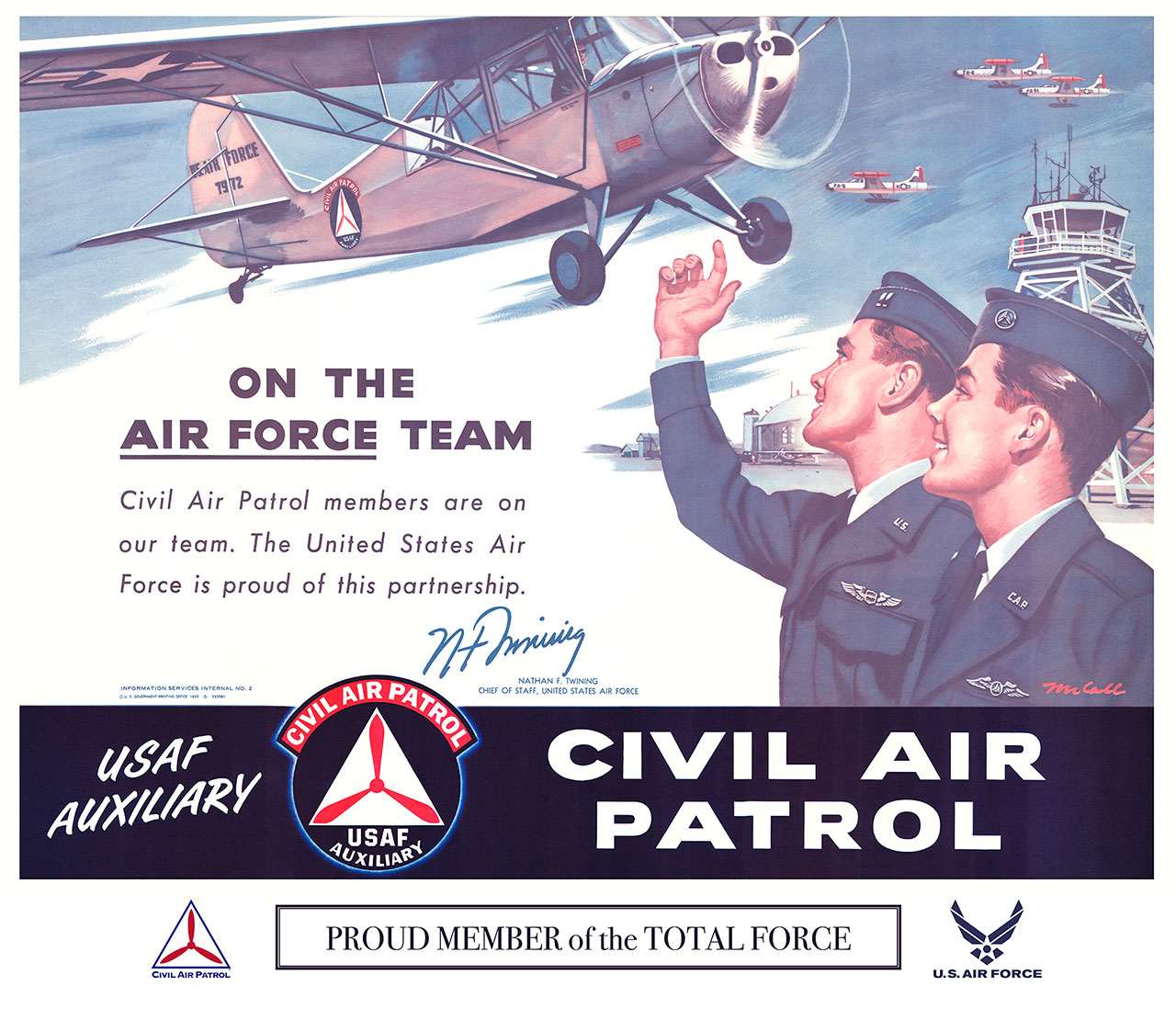
Civil Air Patrol is America’s premier public service organization and the civilian auxiliary of the United States Air Force.
Serving Communities Since 1941
Civil Air Patrol is a congressionally chartered, federally funded, 501(c)(3) nonprofit corporation serving as the civilian auxiliary of the United States Air Force.
Founded on Dec. 1, 1941, CAP was established to mobilize the nation’s civilian aviation resources for national defense service. Today, CAP has evolved into a premier public service organization and a cost-effective force multiplier supporting Air Force-assigned missions nationwide.
Operating in all 50 states, Puerto Rico, the U.S. Virgin Islands, and the District of Columbia, CAP serves communities through emergency services, aerospace education, cadet leadership development, and volunteer service.
Civil Air Patrol Today
Mission-Focused Volunteer Service
CAP’s aviation-connected volunteer professionals come from a wide range of backgrounds and professions united by service, leadership, and commitment to community.
Our Core Programs
Civil Air Patrol fulfills its mission through three congressionally supported program areas serving communities, developing leaders, and supporting the nation.
Civil Air Patrol members perform emergency services missions for local, state, and federal agencies through search and rescue, disaster response, aerial reconnaissance, communications support, homeland security operations, and humanitarian missions.
CAP’s award-winning aerospace education program promotes aerospace, aviation, and STEM careers through engaging curriculum, flight experiences, and hands-on educational opportunities for youth and educators nationwide.
Civil Air Patrol’s cadet program develops youth into dynamic leaders through leadership training, aerospace education, physical fitness, character development, mentorship, and hands-on leadership experiences.
Our Foundation
Mission, Vision & Core Values
Civil Air Patrol’s culture and service are built upon integrity, professionalism, volunteerism, and respect for others.
Volunteers Serving America’s Communities, Saving Lives, and Shaping Futures.
Integrity
Volunteer Service
Excellence
Respect
The origins of the Civil Air Patrol story date to 1936, when Gill Robb Wilson, a World War I aviator and New Jersey director of aeronautics, returned from Germany convinced of impending war. Wilson envisioned mobilizing America’s civilian aviators for national defense.
The proposal for a Civil Air Patrol was approved by the Commerce, Navy, and War departments, and CAP national headquarters opened its doors on Dec. 1. In January 1942, U-boats started attacking the shipping lanes along our east coast. By June, enemy attacks destroyed nearly 400 merchant vessels and oil tankers off the U.S. Atlantic coastline, often within sight of our shores.
Civil Air Patrol was called into action by a short-handed military. With privately owned airplanes armed with light bombs, civilian volunteers became the eyes of the home skies, flying a total of 244,600 hours patrolling and safeguarding America's coastline, aiding the safe movement of war material to the battlefields of Europe and the Pacific.
Today’s Civil Air Patrol may look different, but its core remains the same. It continues to support America’s communities with emergency response, diverse aviation and ground services, youth development and promotion of air, space and cyber power.
In line with the regions are the CAP-USAF Liaison Regions, which are active-duty Air Force offices that provide advice, assistance, and oversight of CAP regions and wings through their respective commanders. At the national level, CAP‐USAF maintains its headquarters at Maxwell AFB along with CAP’s National Headquarters. The CAP-USAF commander commands all civil service and military members of the U.S. Air Force who are assigned to CAP-USAF (including Air Force personnel at the region liaison offices). The CAP‐USAF commander reports to the commander of First Air Force, who reports to the commander of Air Combat Command.
Civil Air Patrol’s Board of Governors is established by Title 10, United States Code (U.S.C.), as the governing body of CAP. It directs and manages the affairs of the corporation. The activities of the 11-member Board of Governors are described in the CAP Constitution and Bylaws and other CAP publications and include selecting, retaining, and removing the National Commander/Chief Executive Officer and the Chief Operating Officer.
Military Makeover
2023 PSA
Supporting U.S. Air Force Air Defense Training
Civil Air Patrol’s Texas Wing supported U.S. Air Force air defense training for Super Bowl LI. These exercises -- Felix Hawk on Jan. 24 and Falcon Virgo on Feb. 1 – are designed to protect the airspace around NRG Stadium in Houston
Volunteers Serving America’s Communities, Saving Lives, and Shaping Futures.